Why it matters
The published figures behind the mission.
Almost every preventable death in a community happens in the minutes before a professional crew arrives. Cardiac arrest, severe bleeding, an overdose, a child in the water, heat illness, a stroke — the difference between the best and worst outcome is usually decided by how quickly the right person, the right equipment and the right knowledge reach the patient.
Those three things are frequently already on the scene. They are simply not connected: the person who is trained does not know the incident is happening, the person at the incident does not know an AED is behind the counter of the shop next door, and the person holding the phone does not know the dispatcher can talk them through what to do.
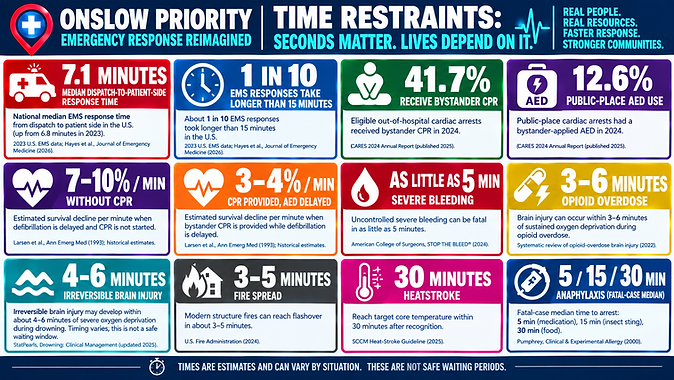
The figures below are the published national context for that problem — what the platform's resource-mapping, community-response, alerting and guidance work is aimed at. They set the size of the problem, and the reason each capability exists.
Every figure below carries the year and the publisher that states it, and each one describes the national picture rather than this deployment.
An emergency is decided in the minutes before a professional crew arrives. Somebody is already standing there. Somebody close by is trained. The defibrillator, the naloxone and the bleeding-control kit are often a few hundred feet away — behind a counter, in a truck, on a wall in the next room. What is missing is not equipment, training or willingness. It is connection: nobody knows a call has gone out, nobody knows who is close enough to help, and nobody can find the equipment that would change the outcome.
The Problem
In an emergency you can't always wait for first responders, and there have been moments where it was too late when help did arrive.
But...
Someone could experience an overdose and a nurse with Narcan is in the parking lot — but the nurse doesn't know. There could be an off-duty EMT right by a choking incident, a marine right by someone bleeding out who has a tourniquet, or a coach with an AED right by a cardiac arrest.
But how can they help if they aren't aware?
They aren't aware, and the patient is alone for minutes, when help can be just around the corner. If they were only aware, critical help would start immediately, saving minutes and lives.
Information fragmentation
When critical details never reach the people who need them, response is delayed. Each box is a piece of the picture held in one place, and what is lost before it reaches the next.
What the caller knows
- Where they are, in their own words
- What they can see from where they stand
- That something is badly wrong
What is lost: Held in one person's memory, spoken once, then gone.
What the dispatcher can hear
- Voice, in the order the caller says it
- Callback number and line location
- Whatever the caller happens to mention
What is lost: Nothing visual, nothing measured, and no way to keep a detail that arrives later.
What the responding crew is told
- A short dispatch text on a screen
- A location and a classification
- A radio channel as they roll
What is lost: The description is compressed three times before it reaches the person who acts on it.
What a bystander could contribute
- Compressions started, and when
- A photograph of the gate or the hazard
- A change in the patient's condition
What is lost: Nobody is listening for it, and it never reaches the unit that is already moving.
Where the equipment actually is
- An AED behind a counter 300 yards away
- Naloxone in a pharmacy bag
- A bleeding-control kit on a wall nobody looks at
What is lost: Registered nowhere, so it cannot be found or routed to in the minutes that matter.
What arrives afterwards
- An account reconstructed from memory
- Times nobody wrote down
- Decisions nobody recorded
What is lost: The next crew, the review and the after-action report all start from a blank page.
Agencies that do not see each other
- Fire, EMS, law enforcement, crisis teams, animal control
- Separate records for one event
- Separate questions to the same caller
What is lost: The same event is reassembled separately, and the gaps sit exactly where coordination should be.
Onslow County is the example, because its registry is public to us. It is not where the need stops: every community that keeps these records shows the same shape, and the platform is built to serve any of them.
Overall survival of cardiac-cause arrests (1,427 resuscitations)
Bystander CPR rate; public AED used in just 5.3%
Median time from the 911 call to the first chest compression
Survival when witnessed and in a shockable rhythm
Who survives
Being seen and helped early is the difference. Unwitnessed arrests, with no one there to act, survive roughly one in fifty.
What stops CPR from starting
Of 269 calls with a barrier recorded. Callers who could not act, or could not be guided, are the gap that nearby trained people and clear spoken steps are meant to close.
Source: Onslow County Emergency Services, CARES Utstein Survival & Dispatcher-Assisted CPR reports, arrests 01/01/2016 to 10/22/2026. County-reported figures, shown as an example of the problem, not as a result of this platform.
Overall survival after an out-of-hospital cardiac arrest. Roughly 10% of the chance of survival is lost for every minute without CPR or defibrillation — which is why the nearest AED and the nearest trained person are the two things worth knowing first.
The order of events — not a measured timeline. This platform does not shorten the time it takes professional responders to arrive, and it does not claim to. It works on what can happen in the minutes before they do.
Overall survival after out-of-hospital cardiac arrest
Bystander CPR rate in adult out-of-hospital cardiac arrest
Bystander AED use in public cardiac-arrest incidents
Fatal overdoses in 2023 where a bystander was present
Heat-related emergency department visits in 2023
Heat-related deaths in 2024
Injury-related emergency department visits in 2022
Drownings a year — about 4,000 fatal and 8,000 nonfatal
Calls to 911 in the United States every year
Roughly how much survival falls for every minute without CPR or defibrillation
Average tornado warning lead time in the United States
Home structure fires a year
Out-of-hospital cardiac arrests a year in the United States
Share of cardiac arrests that happen at home, where an AED is usually not within reach
Strokes a year in the United States
Overdose deaths a year in the United States
PulsePoint, whose community-response model the project presentation cites, reports higher bystander CPR rates and increased public-access AED use in participating communities.
Each figure carries the publisher and the year that publisher states, and each one describes the national picture — the size of the problem the platform is aimed at, and the reason each capability exists.
The photographs on this page were taken at responses in and around Onslow County by the people who built the platform. No names, addresses or incident details are attached to them, and no photograph is presented as an outcome of this platform.
The Solution?
Onslow Priority-Rapid Aid: One unified system meant to leave no one alone or underequipped when seconds count.
The detail behind it
5 sectionsOpen any one to read it.The published figures point the same way every time: the outcome of a time-critical emergency is usually decided before a professional crew reaches the patient, which is why the platform is built around the bystander, the equipment and the information rather than around the ambulance.
- Survival after out-of-hospital cardiac arrest falls roughly 7–10% for each minute without CPR or defibrillation
- Only 41.7% of adult out-of-hospital cardiac arrests receive bystander CPR, and 12.6% see a bystander use an AED
- Nearly half of fatal overdoses had a bystander present at the time
- Severe bleeding can become fatal in minutes, well inside the average ambulance travel time across a rural community
Everything here describes the platform as built, subject to the configuration decisions of the community or agency using it.
Free for the people who need it, anywhere it runs.
It is not tied to one town or one county: a department, agency or community anywhere in the country or the world can run it. Residents are never charged. Departments pay for the parts they use, and donations let us put more resources into a community that could not otherwise afford them.
- · Defibrillators, naloxone and bleeding-control kits
- · Guides, voice instructions and training material
- · Mapping the equipment a community already has
Questions, corrections, or a resource we have missed — reach the team directly.